
Building Artificial Intelligence That Mimics Individual Preferences by Combining Deep Learning and Functional MRI
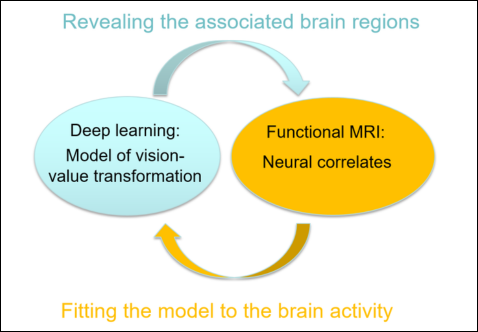
Deep learning is a subset of machine learning that has achieved high performance in various cognitive tasks, particularly in computer vision. Interestingly, recent studies have revealed that the information represented by artificial neural networks trained using deep learning resembles that of the human visual system (Yamins et al., 2014, PNAS; Güçlü & van Gerven, 2015, J. Neurosci.).
Our group aims to build artificial intelligence that mimics individual preferences by combining deep learning with functional MRI (fMRI). As a related project, we have developed painting recommendation systems that estimate individual preferences from subjective ratings and recommend artworks accordingly.
We have also investigated the consistency of aesthetic preferences across different categories, including artworks, scenic photographs, and faces. Our results showed that individual preferences in one category can be used to predict preferences in another category (Pham & Chikazoe, Frontiers in Neural Circuits, 2026).
You can try our painting recommendation systems using the following links:
- Recommend paintings based on your preferences for artworks
- Recommend paintings based on your preferences for photographs
- Recommend paintings based on your preferences for male faces
- Recommend paintings based on your preferences for female faces
Related Publication:
Looking for the Elementary Units of the Mind Through Large-Scale Neuroimaging Data Analysis
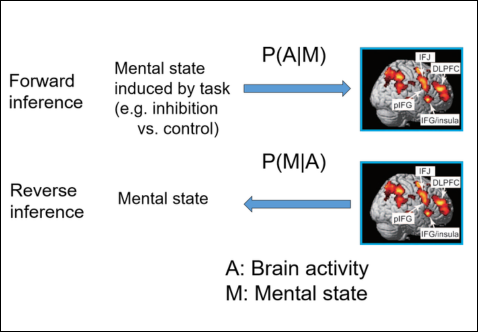
It is known that we can identify correspondences between brain regions and cognitive functions through appropriately designed psychological experiments (forward inference). However, inferring a participant's mental or cognitive state from brain activity (reverse inference) remains challenging. Previous studies have shown that a single cognitive function involves multiple brain regions, while a single brain region can be associated with multiple cognitive functions. These findings suggest that the relationship between brain regions and cognitive functions is many-to-many rather than one-to-one (Barrett & Satpute, 2013; Yarkoni et al., 2011).
Our group believes that clarifying these many-to-many relationships will help us make more appropriate reverse inferences. For a more detailed discussion, please refer to our 2017 presentation, “Reverse Inference Problem”.
We have also shown that combining conventional functional connectivity analysis with a novel approach based on spatial patterns of brain activity within individual regions improves the prediction of individual traits and behaviors from resting-state fMRI data (Yoshimoto et al., NeuroImage, 2024).
In fiscal year 2026, our research project, “Building an fMRI Foundation Model: Toward Personalized Medicine and Uncovering the Fundamental Units of the Mind,” was selected for funding under the International/Convergence research type of the Japan Science and Technology Agency's AI to Redesign Scientific Exploration (ARiSE) program.
Related Publications and Information:
Neural Basis of Human Taste Perception
Studies in rodents and nonhuman primates have established the insular cortex as a key region involved in gustatory processing. However, how different taste qualities are represented in the human brain had long remained unclear.
Our laboratory demonstrated that distinct patterns of brain activity in the insular cortex allow four basic taste qualities—bitter, sweet, sour, and salty—to be distinguished (Chikazoe et al., Nature Communications, 2019).
Building on these findings, we aim to further elucidate the neural mechanisms underlying human taste perception by applying machine learning and other computational approaches.
Related Publication:

Development of Biomarkers for Psychiatric and Neurological Disorders
The diagnosis of psychiatric disorders and the evaluation of treatment outcomes rely largely on clinical assessments. From the perspective of evidence-based medicine, there is a growing need for objective biomarkers that can complement clinical decision-making.
In recent years, researchers have applied machine learning to resting-state fMRI data to develop potential biomarkers for diagnosing psychiatric and neurological disorders and evaluating treatment responses. However, challenges involving predictive accuracy, reproducibility, and generalizability must be addressed before these approaches can be reliably applied in clinical practice.
Our laboratory aims to develop novel methods for analyzing brain function that go beyond conventional functional connectivity analysis and to explore their potential applications to biomarkers for psychiatric and neurological disorders.
We have previously demonstrated that novel analytical approaches to resting-state fMRI data can improve disease classification accuracy.
Our current research focuses on developing deep learning-based methods for analyzing functional connectivity between brain regions, with the goal of predicting individual traits and identifying brain activity patterns associated with psychiatric and neurological disorders.
Related Research Programs: